

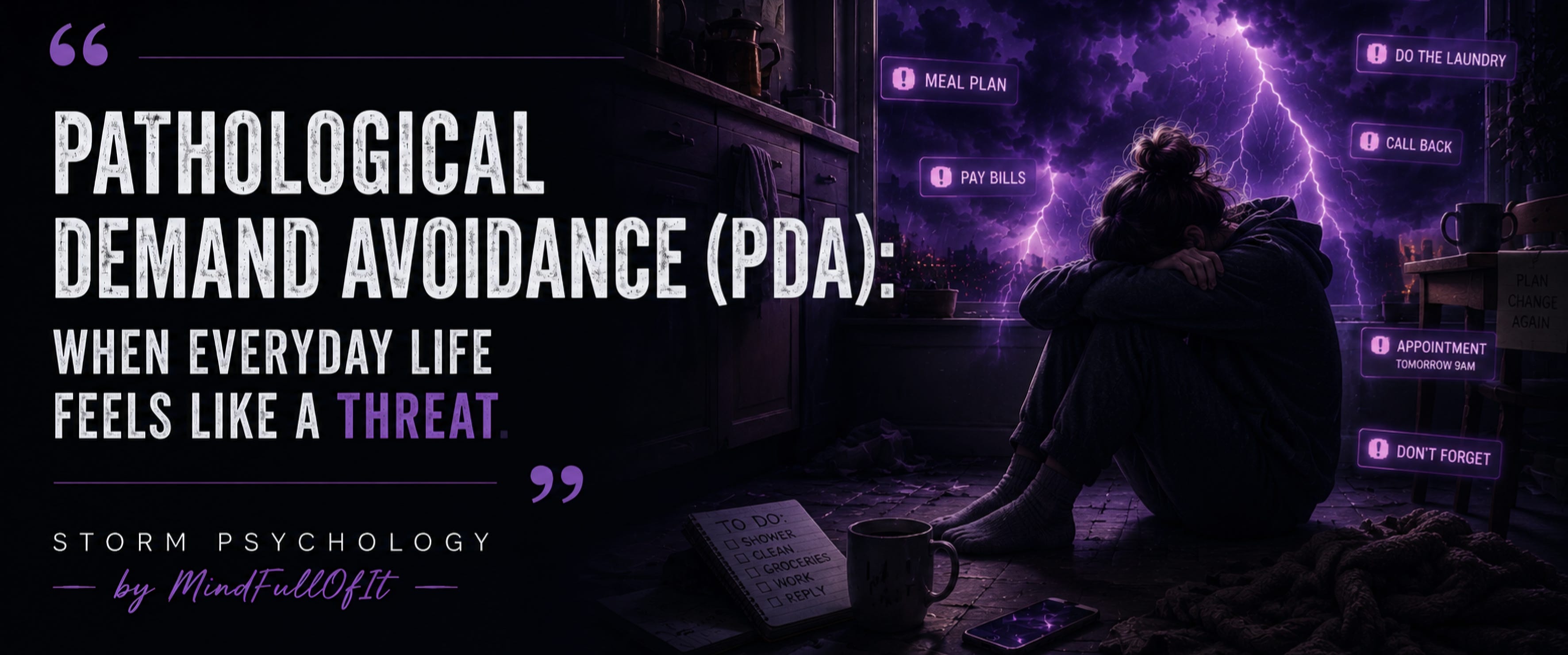
Pathological Demand Avoidance (PDA): When Everyday Life Feels Like a Threat
Understanding the intense threat response and demand avoidance often linked to autism and neurodivergence.

You were going to do it.
That’s the frustrating part.
You had already thought about replying to the text, making the phone call, emptying the dishwasher, sending the email, booking the appointment. Somewhere in your brain, the task already existed on today’s mental to-do list.
Then somebody asks you about it.
And suddenly your entire body reacts like they’ve pressed an invisible alarm button.
The task feels heavier now.
Hotter somehow.
Your brain starts pushing against it almost instantly.
You might procrastinate, shut down, leave the room, snap defensively, or feel an overwhelming urge to do literally anything else instead.
Not because you’re lazy.
Not because you don’t care.
Not because you’re trying to be difficult.
But because for some people, pressure and expectations can trigger a genuine nervous system threat response.
Like an inner storm system switching on without warning.
“Sometimes the hardest part isn’t the task itself. It’s the feeling of losing control over it.”
This is one of the reasons Pathological Demand Avoidance (PDA) is so misunderstood.
From the outside, people often see avoidance. What they do not see is the panic, overwhelm, shame, or internal fight happening underneath it. The person themselves usually knows the task is manageable. That’s often what makes the experience so confusing and distressing in the first place.
The storm is happening internally, long before anybody else notices the weather changing.
What Actually Is PDA?
Pathological Demand Avoidance, usually shortened to PDA, is most often talked about as a profile linked to autism, particularly in the UK. You might also hear people discuss PDA alongside ADHD, anxiety, trauma, burnout, or other forms of neurodivergence and overwhelm.
Research around PDA is still developing, and conversations about it online can become… intense. Spend long enough reading comment sections and you’ll quickly realize humans can turn absolutely anything into a gladiator fight with WiFi.
But underneath all the debates, many people describe a surprisingly similar experience:
Everyday demands can trigger intense feelings of pressure, panic, overwhelm, or loss of control.
And the strange thing is, the demand itself is often tiny.
Not dramatic, movie-scene life crises. Not running through explosions in slow motion while Hans Zimmer music plays in the background. Sometimes it’s replying to a text message. Choosing what to eat. Showering. Opening emails. Making a phone call you’ve already rehearsed seventeen times in your head.
Sometimes even enjoyable things stop feeling enjoyable the second they become expected.
“You can genuinely want to do something and still feel your nervous system pushing against it.”
From the outside, this can look confusing. One day somebody manages something perfectly fine. The next day the exact same task suddenly feels impossible to start.
People often mistake this for laziness, manipulation, bad behavior, or “not trying hard enough.” In reality, many people with PDA describe feeling trapped between what they logically want to do and what their nervous system suddenly feels able to tolerate.
And honestly, that internal fight can be exhausting.
Especially because the person usually knows the task should not feel this difficult. That’s part of what makes the shame hit so hard. For reasons nobody fully understands yet, the brain can sometimes react to ordinary expectations like they’re emergency alarms.
By the time logic catches up, the inner storm is already in full swing.
One of the hardest parts of PDA is how invisible it can be from the outside.
People usually see the cancelled plans, the unopened messages, the avoidance, the procrastination, or the sudden emotional reactions. What they do not always see is the amount of energy being spent internally trying to manage the pressure building underneath it all.
Because for many people with PDA, everyday life can start to feel like constant negotiation.
Not dramatic negotiation either. Not standing on tables screaming into the void while orchestral music plays in the background. Tiny negotiations. Quiet ones. The sort that happen internally all day long.
Can I answer that message now or will it suddenly feel overwhelming?
Can I start this task without panicking halfway through?
Why does replying to one email feel like I’m preparing for psychological warfare?
And honestly, that level of constant self-management can become exhausting very quickly.
Some people with PDA become incredibly good at masking it. They might look calm externally while internally their nervous system is already halfway into fight, flight, freeze, or shutdown over something other people would barely think twice about.
“Some people spend so long fighting the storm internally that nobody notices how tired they are becoming.”
And because the struggle is mostly invisible, many people grow up hearing the same things over and over again:
“You just need to try harder.”
“Stop making excuses.”
“You were fine yesterday.”
“Why are you making such a big deal out of this?”
Which usually creates even more shame, pressure, and overwhelm… exactly the things the nervous system was struggling with in the first place.
PDA in Adults: The Part People Miss Most
A lot of PDA conversations still focus entirely on children.
And while understanding children matters massively, those children eventually grow up into adults who are often carrying years of shame, confusion, burnout, masking, and being misunderstood.
Some adults with PDA spend years believing they are:
lazy
unreliable
dramatic
“bad at coping”
terrible at life management
secretly just failing at being a normal human
When actually, many have been living with a nervous system that reacts to pressure like it’s a threat alarm.
And the thing that makes this especially confusing is that PDA is not usually a lack of intelligence, motivation, or awareness.
In fact, many people with PDA are painfully aware.
They know the email needs replying to.
They know the appointment matters.
They know the dishes are there.
They know avoiding it will probably make the anxiety worse later.
That awareness does not magically switch the storm off.
“Knowing what needs to happen and feeling able to do it are not always the same thing.”
A lot of adults with PDA become experts in masking too. Some appear highly capable on the outside while privately living in a constant state of internal negotiation and exhaustion.
People often only see the moments where someone did manage the task. They do not see:
the hours of mental build-up beforehand
the panic afterwards
the recovery time needed
or the amount of energy it took just to appear “fine”
And honestly, living like that can become incredibly isolating.
Especially when other people keep responding with things like:
“Everybody has to do things they don’t want to do.”
Which is technically true, but also completely misses the point.
This is not usually about disliking tasks. It is about the nervous system reacting intensely to pressure, expectation, or perceived loss of control in ways that can feel overwhelming very quickly.
For some people, the internal storm never fully switches off. They simply become very good at hiding the weather.
What Actually Helps?
One of the biggest mistakes people make with PDA is assuming more pressure will somehow solve the problem.
Usually it does the opposite.
More pressure often creates:
more overwhelm
more panic
more shutdown
more avoidance
more shame
Which then creates even more pressure afterwards because now the task has emotional baggage attached to it too. Human brains really do love turning one unfinished email into a full psychological haunting.
For many people with PDA, feeling safe matters more than feeling controlled.
That does not mean “never having responsibilities” or removing every expectation from life forever while living peacefully in a forest eating cereal out of mugs. Unfortunately, bills continue to exist for all of us.
But it does mean understanding that nervous systems usually function better when they feel:
collaborative instead of trapped
supported instead of judged
flexible instead of cornered
safe instead of constantly criticized
Sometimes small changes can reduce the internal storm massively:
having choices instead of commands
reducing unnecessary pressure
breaking tasks into smaller steps
using humor
allowing recovery time after overwhelm
understanding that shutdown is not the same as laziness
And honestly, one of the most powerful things for many people is simply hearing:
“You are not a bad person for struggling with this.”
Because a lot of people with PDA have spent years being treated like the problem is their personality, rather than recognizing the amount of invisible distress happening underneath the surface.

The Part I Wish More People Understood
A lot of people with PDA are not refusing because they want life to be difficult.
Most are already fighting a storm internally that other people cannot see.
And when somebody spends years feeling misunderstood, judged, pushed, criticized, or ashamed for struggles they cannot fully explain themselves, that starts to shape the way they move through the world.
Some become highly avoidant.
Some become people-pleasers.
Some mask until they burn out completely.
Some become experts at looking “fine” while quietly drowning underneath the pressure.
Because survival does not always look dramatic.
Sometimes it just looks like somebody replying:
“Haha yeah all good”
while internally their nervous system is setting off every alarm it has.
And honestly, I think that is why conversations around PDA matter.
Not because people need another internet label to fight about in comment sections at 2am while eating dry cereal out of the box.
But because understanding changes the way we respond to people.
When we stop seeing somebody as:
lazy
manipulative
dramatic
difficult
…and start recognizing overwhelm, fear, pressure, shutdown, and nervous system distress underneath the behavior, the conversation changes completely.
That does not magically remove responsibilities, struggles, or consequences from life. But compassion and understanding usually help people far more than shame ever has.
Especially when so many people have spent years believing they were simply broken.
“Sometimes the storm was never visible because the person experiencing it became too good at hiding the weather.”
And if this post made you feel recognized in some way, whether for yourself, your child, your partner, or somebody you care about, I hope it reminds you of something important:
Invisible struggles are still real.
Even when other people cannot see the storm yet.
If this post made you feel seen, understood, emotionally attacked by your own unread emails, or suddenly aware that your nervous system has apparently been running a private weather system for years… you can support Storm Psychology by subscribing, sharing, commenting, or throwing a snack-shaped life raft my way 🌩️☕️
Paid subscriptions are currently 20% off if you’d like to support more long-form psychology posts like this, the stormy visuals, and the increasingly concerning amount of emotional damage caused by dishwasher conversations.
And honestly? Even a comment or share helps more than people realize. These conversations matter.